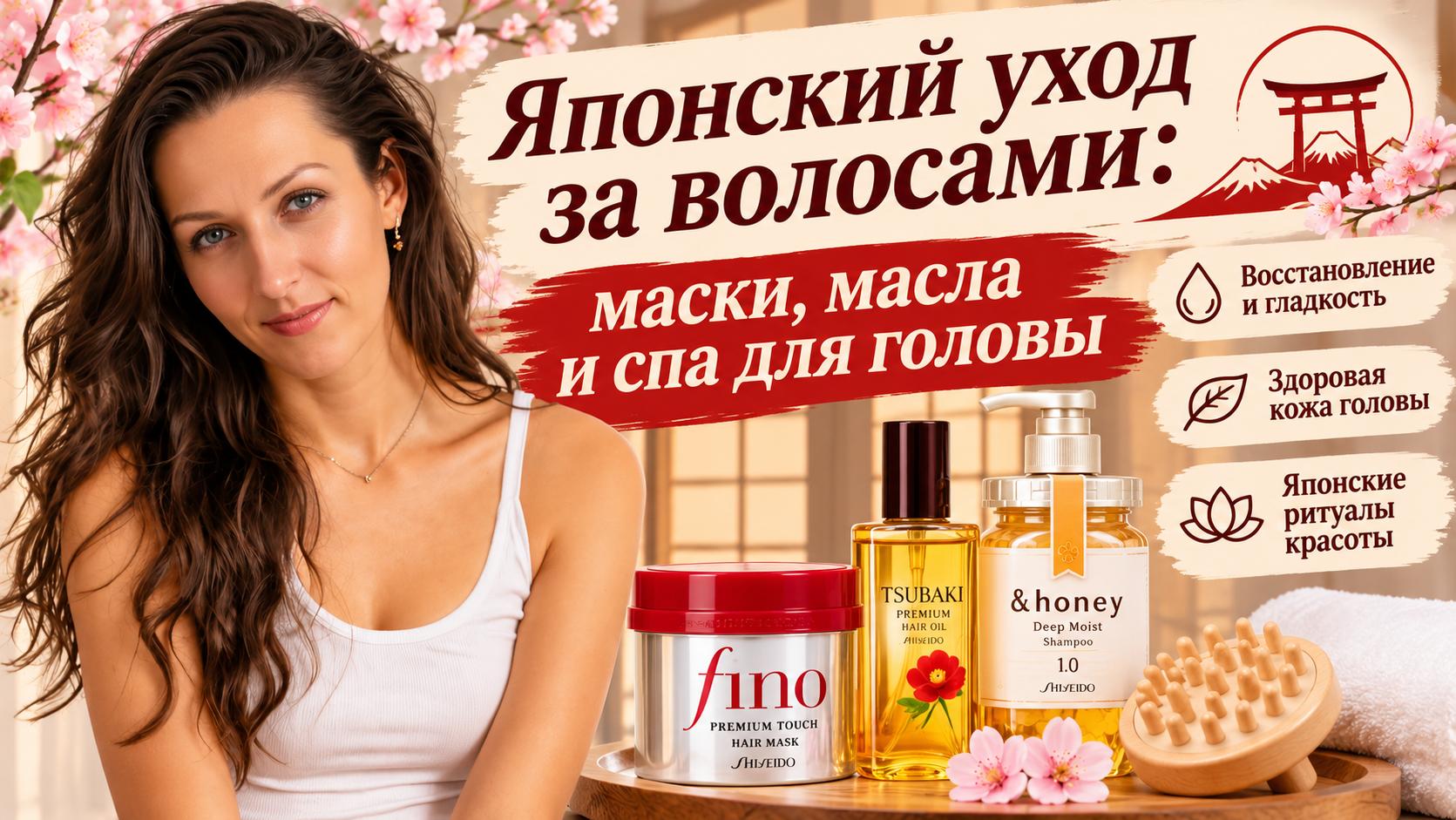
Hi, it’s Mila, and today I’ll tell you about Japanese hair care — a direction where even an ordinary shampoo looks like part of a ritual. The Japanese treat hair the way they treat facial skin: gently, systematically and with great respect for the scalp. I’ll tell you what’s in use there, why cult masks have won fans all over the world, and what’s worth borrowing for your home routine )
Why Japanese hair is “on another level”
The secret isn’t in one jar but in the culture of the approach. Hair in Japan is seen as a continuation of the skin: its condition begins at the scalp, which is why the scalp care section there is so strong — scrubs, tonics, ampoules, massage. The culture of “head spa”, a salon scalp massage with treatment, isn’t an indulgence but a basic procedure for many. The formulas are gentle: Japanese shampoos are often slightly acidic and free of harsh degreasing, because the main principle is not to destroy what you then spend half an hour restoring.
What counts as a hit there
- Multitasking masks. The cult Fino mask, which almost everyone has heard of, is a dense, rich “five minutes and your hair feels like after a salon” formula. People there buy these masks in packs and pass them on to friends like a secret.
- Oils for the ends. Light, fast-absorbing: one drop on damp or dry ends — protection against splitting and frizz.
- Gentle shampoos. Focused on hydration and the scalp rather than “loud cleanliness”.
- A scalp care section. Scalp tonics and scrubs — something just coming into fashion here, but long standard in every pharmacy there.
I like the very idea that “hair grows from the scalp” — it’s honest. I have my own story about systematic home care: in the article about a year of a simple system I explain how my hair grew longer and thicker without expensive products. And if volume is your thing, take a look at the review of dry hair powder: the Japanese fashion for volume at the roots fits here perfectly )
What to borrow for your home care
- Five minutes of mask — as a ritual. Once a week, a rich mask on the ends with a towel over your head: warmth boosts how the formula works.
- Conditioner — not on the roots. From mid-length down: the roots stay light, the length gets nourishment.
- A final rinse with cool water. The cuticle closes — hair is smooth and shiny.
- A scalp massage every day. A couple of minutes with your fingertips while applying shampoo: circulation and relaxation in one step.
- Moderate heat. The dryer on a medium setting, held away from the roots.
What to keep in mind
- Rich masks don’t suit fine hair without measure: once a week — yes, every day — no.
- Check formulas for fragrance and silicones if your scalp tends to get irritated.
- Japanese products aren’t always easy to find in the original version: don’t buy from no-name sellers — fakes in this segment are more common than you’d think.
And a small observation at the end: the Japanese approach works so well precisely because it’s calm. No “thirty new products at once” — only stable, gentle steps that take no more than a couple of minutes. If I had to pick one habit from the whole list, I’d start with a scalp massage: it’s free, pleasant and good for the scalp even without any jars. Over time the mask and the cool rinse will join in on their own — that’s usually how a system grows: from one favorite step, not from a huge plan for Monday.
Which of the Japanese habits seems most realistic to you — the mask, the massage or the cool rinse? Write in the comments, I read every one and collect new topics )