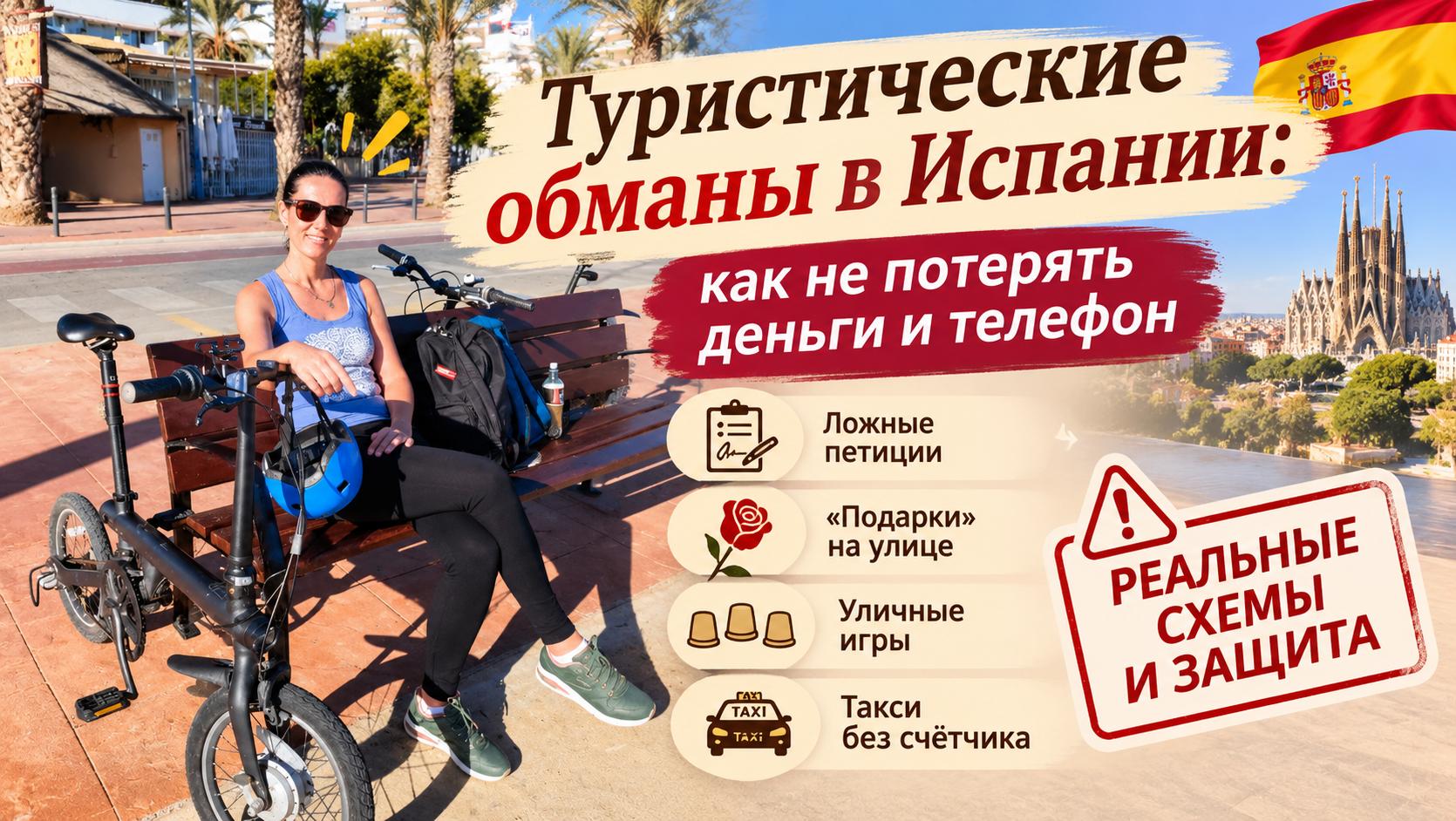
Every season, on the beaches and at the stations of Spain, “artists” appear whose work is other people’s wallets and phones. Hi, it’s Mila again, and today I’ll share a cheat sheet of what the most common street schemes in Spanish cities look like and how to walk around calmly, without turning into a paranoid person. This is not a reason to panic — it’s just a list of habits worth updating before a trip.
Schemes you’ll come across most often
- The request to sign a “petition.” A person comes up to you with a tablet and a stack of papers about “deaf children” or the environment. While you read, their fingers “help” undo the zipper of your backpack. Usually they work in pairs: one chats, the other works.
- The flower and the “gift.” Someone holds out a rose or a bracelet with the words “a gift,” and then demands payment and follows you. The rule is simple: don’t take from someone’s hands anything you’re “given” on the street.
- Thimbles and “guess the card.” A street game where the only one who loses is the one who bets money. Around the table are ringers who cheerfully win and pull in the crowd.
- Spilled water or ketchup. One person “accidentally” stains your clothes, a second one is ready to “help,” and a third takes the bag off your shoulder in the meantime.
- Taxi without a meter. At night outside clubs the price is “negotiated on the spot” — and it is three times higher than usual. Ask them to turn the meter on or take a cab from an official rank.
- “Police” in plain clothes. Real officers don’t ask to see your wallet and don’t take cash “for inspection.” Firmly ask them to show ID and suggest going to the station together.
Where the risks are higher
Risk spots are the same in any city: metro entrances, railway stations, bus stops where people stand with suitcases, viewpoints and packed beaches. In Barcelona and Madrid these are the famous streets with the highest density of tourists, and on the coast — bus stops and evening markets. I’ve noticed a pattern: the more “rehearsed” a person’s approach to you is, the more carefully you need to hold your bag. The locals, by the way, walk these same streets with their bag in front of them — not because they’re afraid, but because it’s a habit.
How I protect myself on a trip
- at a terrace cafe I don’t put my phone on the table — straight into a pocket or the inner compartment of my bag;
- in the metro the bag is on my chest, the strap across my shoulder, pockets zipped;
- part of the money and a second card are in different places, copies of documents — in the cloud;
- on the beach I don’t leave my things unattended for a minute, even “behind the umbrella”;
- I don’t count money on the street and don’t check a large sum at the exchange window.
If it happens anyway
First — calm down: things aren’t worth nerves and health. Emergency services are 112, a single number for the whole country. About the report: the phone intake of police reports has already been switched off in the usual order — a report is now filed through the police website, and for filing in English there is a separate line in Madrid on weekdays during the day. Then — block the cards, change passwords and, if the phone is gone, log out of banking apps from another device. And to understand how the country’s emergency alert system works at all, look into my article about the emergency alert in Spain — it also covers what to do if your phone suddenly “wails.” And don’t confuse scammers with real inspections: how the holiday checks in Benidorm go is a separate, perfectly polite story.
Instead of a conclusion
Spain is a welcoming country, and most of the people you meet are indifferent to your pockets in the best sense. Just move your habits a couple of steps forward — and the street “artists” will be left without work )
Has anything like this ever happened to you on your travels? Tell me in the comments — your experience might save someone’s vacation.